China Furniture Sourcing Agent: How to Source Furniture from China in 2026

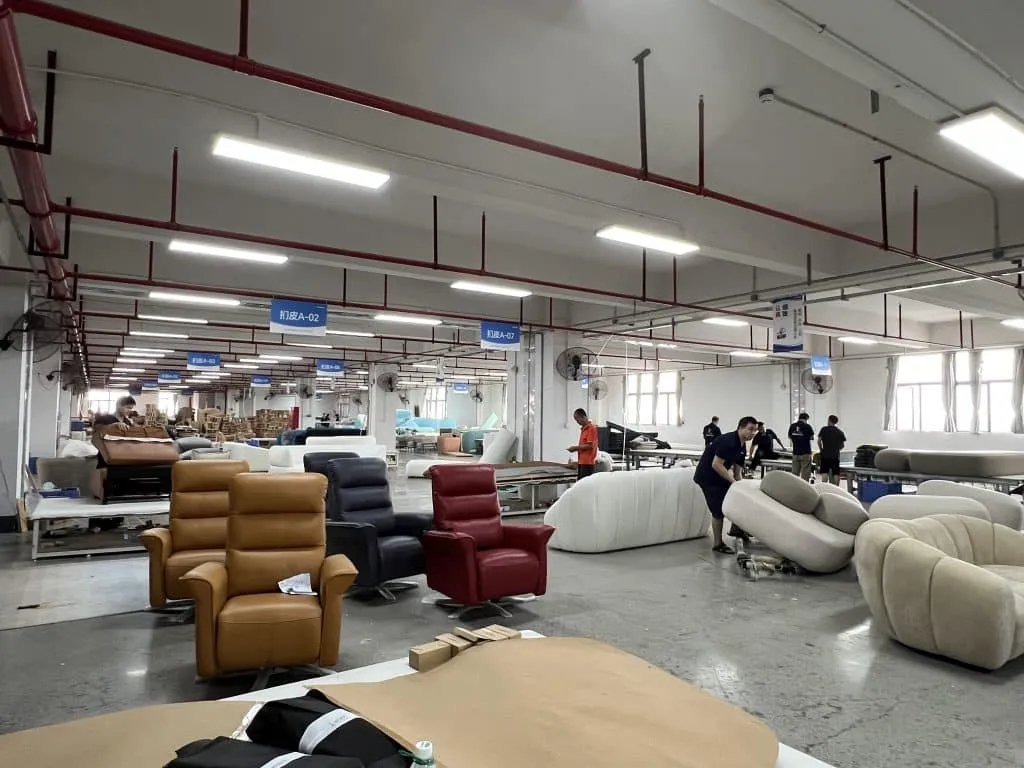
Last November I stood in a loading bay in Leliu, part of Foshan’s Shunde district, watching 340 accent chairs go into a 40HQ container. The buyer was a DTC furniture brand from Texas who had sourced the same chair himself eighteen months earlier. His first order: $27.40 per unit FOB, 6.4% of the shipment arrived damaged, and the cartons were so badly sized that his container filled at 52 cubic meters instead of 65. His second order, placed through us: $23.90 per unit, 65.8 cubic meters loaded, and 0.9% damage. Same factory. Same chair. The difference was not a magic discount — it was packing engineering, a proper tech pack, and someone standing in the factory at 6 a.m. on loading day.
That is what a China furniture sourcing agent actually does. Not “find a supplier” — that part takes a week. The value is in the hundred small decisions between a quote and a container that arrives clean.
I’m Angel, CEO of SinoSourceAgent. I’ve spent more than ten years sourcing for importers, and furniture is the category where I see the widest gap between what buyers expect and what the factories actually deliver. In this guide I’ll show you how furniture sourcing really works in 2026: the production clusters, the compliance tests that can stop your container at customs, the cost math, the MOQ traps, and the honest trade-offs of doing it yourself.
What a China Furniture Sourcing Agent Actually Does
Let me start by killing a common misconception. A furniture sourcing agent is not a broker who forwards your inquiry and marks up the price. If that is what you’re getting, you’re paying for nothing.
Here is the actual scope of work on a typical furniture project:
- Tech pack creation. Factories quote what you describe. If you send a photo from Pinterest, you get a guess. A proper tech pack has dimensions, tolerances, materials with density and thickness specs, hardware, finish, packing method, and a labeled sample reference. This single document usually moves quotes down 5–12% because factories stop padding for ambiguity.
- Cluster matching. Office chairs and metal-frame seating come from different towns than solid-wood dining tables. Sending one RFQ to the wrong cluster means you get a trading company’s margin instead of the factory’s price.
- Compliance screening. Composite wood, upholstery, foam, and mattresses each trigger different US and EU requirements. I’ve seen $40,000 containers held because nobody asked for a formaldehyde test report.
- Sampling and gold samples. Furniture samples are expensive and slow — but the sealed “gold sample” that stays in the factory is what protects you at final inspection.
- Packing and container engineering. In furniture, packing is the product. Knock-down designs, corner protection, carton dimensions matched to pallet and container math.
- Inspection and loading supervision. Pre-shipment inspection plus physical loading supervision, because a container loaded carelessly damages goods that passed every check.
- Documentation and freight. Fumigation, ISPM 15 for wooden crates, HS classification, and FCL or LCL booking depending on volume.
If you want the broader picture of how sourcing scope and fees compare across agents, our guide to sourcing agents’ real fee structures breaks the numbers down honestly.
Why Furniture Breaks the Normal Sourcing Playbook
Most sourcing advice online is written for electronics and accessories — small, light, high value density, air-shippable. Furniture is the opposite, and the differences matter:
Value density is brutal. A 40HQ holds roughly 65–68 usable cubic meters. A boxed three-seater sofa eats 1.1–1.5 cbm. That is around 45–60 sofas per container. If your sofa costs $180 FOB, your freight per unit at $3,400 per container lands around $60–75 — 30%+ of your product cost. Every cubic meter saved by better knock-down design is real money, and a sourcing agent who ignores container math is not doing the job.
MOQs are volumetric, not unit-based. Factories think in production runs: a cutting table, a spray line, a sewing line. A “MOQ of 100 pieces” for a metal-frame chair might be 100 pieces per color per frame size. Buyers who don’t confirm this end up with three containers of a color they can’t sell.
Lead times are long and lumpy. Standard furniture production runs 45–75 days after sample approval, plus 25–38 days of ocean transit. That means a November order for a spring season is already late. Our seasonal sourcing calendar maps this month by month, including how Chinese New Year knocks six weeks out of your year.
Damage risk is the real margin killer. Industry claims data for poorly packed furniture frequently runs 3–8% of value. At a 5% damage rate on a $40,000 shipment, you’re losing $2,000 — which is more than the “savings” most buyers chase by arguing over 3% on unit price.
Samples are slow and costly. A real upholstered sofa sample from a mid-size factory runs $300–900 plus 15–25 days. Chairs and flat-pack pieces are cheaper, $80–200. Budget for two rounds: a prototype and a corrected pre-production sample.
The Furniture Clusters (and Why Foshan Is Only Half the Answer)
China’s furniture industry is a set of specialized towns, and picking the right one is the single biggest determinant of your price.
| Cluster | Specialty | Typical strength |
|---|---|---|
| Shunde / Lecong, Foshan (Guangdong) | Sofas, upholstered seating, dining sets, bedding | Biggest showroom concentration (Lecong Furniture City), strong export experience |
| Dongguan (Guangdong) | Leather and fabric sofas, hotel and commercial furniture | Deep export documentation know-how, larger factories |
| Anji, Huzhou (Zhejiang) | Office chairs, mesh task seating | Component suppliers everywhere — cheapest chair cluster |
| Nankang (Jiangxi) | Solid wood bedroom and living room | Vertical integration from drying to finishing |
| Bazhou (Hebei) | Metal-frame and melamine furniture | Low labor cost, budget price points |
| Haining (Zhejiang) | Upholstered sofas, leather | Good middle tier for European buyers |
Here’s the trap. A Foshan sofa factory is an excellent partner for sofas and a poor one for an office chair; if you insist, they will accept your order and subcontract it. Our breakdown of China’s manufacturing regions goes deeper into how cluster specialization shapes cost and quality, and our city-by-city sourcing guide helps you shortlist before you book flights.
Also worth deciding early: are you talking to a factory or a trading company? For furniture, both can be right. A good trading company bundles five items into one container and handles paperwork; a factory gives you the best price on one high-volume item. The trade-offs are laid out in trading company vs factory in China.
Materials, Compliance and the Tests That Actually Matter in 2026
This is where importers get hurt, because furniture compliance is not one rule — it’s a stack.
Composite wood (MDF, plywood, particleboard). Anything sold into the United States containing composite wood must comply with CARB Phase 2 and TSCA Title VI formaldehyde limits. Ask for a third-party test report (SGS, BV, Intertek) on the board supplier, not just a factory certificate. Engineered wood is where cheap factories quietly cut corners.
Upholstered goods. In California, fabric and foam must meet TB 117-2013 flammability requirements, and foam density is the spec most often quietly downgraded — 25D foam becomes 18D and the sofa feels different after 90 days. Put density, ILD, and fabric weight in grams per square meter directly into your spec sheet.
Office seating. BIFMA X5.1 testing (or equivalent ANSI/BIFMA) is what commercial buyers ask for. Cycle testing on gas lifts and tilt mechanisms is where low-cost chairs fail first.
Mattresses. US imports fall under 16 CFR 1632 and 1633 — ignition resistance plus labeling. Miss the label requirements and your goods can be refused even if the product is fine.
Wood sourcing and the EU. If you sell into the EU, the EU Deforestation Regulation covers wood and wood-based furniture and requires geolocation-based due diligence on the timber in your products. The deadlines have already been deferred more than once, so verify the current compliance date for your company size with your agent before you plan a launch. The EU’s General Product Safety Regulation also adds obligations around traceability and responsible economic operators — for furniture brands this typically means an EU-based responsible person.
Practical takeaway: build a compliance checklist per SKU and get test reports before production, not after. Retrofitting compliance on a finished container is not a thing.
The Real Cost Math: Where Furniture Margins Hide
Let me show you a simplified but realistic 2026 example for a mid-range fabric sofa, 50 units, FCL to the US West Coast.
| Line item | DIY buyer (first order) | With an agent |
|---|---|---|
| Unit price FOB Shenzhen | $180.00 | $166.00 |
| Container fill | 48 cbm (inefficient packing) | 65.5 cbm |
| Freight + surcharges per unit | $88 | $58 |
| Duties and fees per unit (incl. Section 301 where applicable) | $41 | $37 |
| Damage and rework allowance | $11 (6% at cost) | $3 (1.5%) |
| Inspection / sampling cost per unit | $4 | $5 |
| Landed cost per unit | $324 | $269 |
That is a 17% gap — roughly $55 per sofa, $2,750 per container. The agent’s fee on an order like this, at a typical 5% commission, is around $415. The reason the math works is not that agents negotiate 8% better than you (sometimes we do, sometimes not) — it’s that packing design, container fill, and damage prevention are worth far more than the unit price.
The honest trade-off: if you are importing 20 chairs twice a year, the fee may genuinely not pay for itself, and I’ll tell you that. The math flips around the point where you’re booking full containers and carrying real inventory risk. On tariffs specifically, rates on Chinese furniture have moved repeatedly since 2018 — furniture is one of the categories where the classification and origin documentation matter most, and our China import duty guide walks through HS codes and landed-cost calculation.
Quality Control for Furniture: What We Check Before It Ships
Furniture QC is a different discipline from consumer goods inspection. Here’s what actually gets checked on our projects:
- Pre-production sample approval. Once production spec is agreed, the approved sample is sealed with signatures and stays at the factory.
- Moisture content. Wood should be dried to roughly 8–12%. Above that and you ship a product that cracks or warps in a dry, heated home. We use moisture meters during inline inspection.
- Frame and joint testing. Stress tests on joints, seat load cycling, and a simple sit-and-rock test will catch most structural problems before they become returns.
- Foam and fabric verification. Density measurement, fabric weight verification against spec, and color consistency against the approved swatch under multiple light sources.
- Hardware check. Screws, cam locks, and fittings must be counted per carton, and we push for 3–5% spare hardware in every box — it’s the cheapest return-rate reducer in the industry.
- Carton and drop testing. Carton drop test and stacking strength checks, plus a “ship test” where possible. Furniture rarely fails at the factory; it fails between the factory and the customer’s door.
- Container loading supervision. Physical supervision of loading, with photos of every row: how pallets are braced, how cartons are stacked, whether desiccants are placed. Container humidity is a real problem for wood and upholstery on long sea routes.
If you want the full inspection framework, our quality control service page explains how inspection stages are sequenced, and the sample ordering process explains how to run sample rounds without losing a month.
MOQs, Tooling and Samples: How We Lower the Barrier
Furniture MOQs intimidate first-time importers. They are also more negotiable than they look:
- Shared components. If a factory already makes a similar frame, using their existing mold for a new fabric or finish cuts MOQ by 50% or more.
- Mixed-SKU containers. Assigning your 100-unit MOQ across two or three SKUs from the same factory keeps the production run viable and spreads your risk.
- Tooling amortization. For injection-molded plastic parts or custom metal tube bending, ask for the tooling fee to be split across the first three orders instead of paid upfront.
- Grouped production. A sourcing agent working with several buyers in the same category can place a combined run — you get factory pricing at half the volume.
- Packing as a MOQ lever. Custom-printed cartons usually force their own MOQ (often 1,000+). Plain cartons plus a printed label is a legitimate way to launch smaller.
Red Flags: When to Walk Away
- The quote arrives in under 24 hours with no questions about your spec.
- They cannot name the board supplier or provide a formaldehyde test report.
- Foam density is described only as “high density” — no number, no ILD.
- They push you to pay 100% upfront, or ask for a payment to a personal account.
- Their “factory photos” are watermarked stock images you can reverse-search to another company.
- The unit price is 40% below every other quote. In furniture that usually means thinner board, cheaper foam, or an unmixed batch.
The most reliable protection is process: verify the supplier, contract with clear specs, pay in stages, and inspect physically. Our supplier verification framework covers how to vet a furniture factory in about a week, and staged payments keep your deposit protected.
Working With a Furniture Sourcing Agent: What Good Looks Like
If you decide to work with an agent — ours or anyone else’s — insist on these five things:
- A written scope covering tech pack, supplier shortlist, sampling, inspection, and loading supervision. Anything less is a broker.
- Transparent factory pricing. You should see the factory invoice or at least a documented quotation. Markup hidden inside unit price is how agents quietly take 30%.
- Named factories and cluster reasoning. Ask why this factory, in this town, for this product.
- A compliance owner. Someone must be accountable for test reports and labeling.
- Loading photos. Non-negotiable on every container.
We run furniture projects end-to-end — from tech pack to container leaving the port — through our product sourcing service, and freight, consolidation, and door delivery through logistics management. If you’d like a second opinion on a quote you already have, send it over: contact us and we’ll tell you honestly whether it’s competitive, with the cost breakdown behind that answer.
The Bottom Line
Furniture is not a hard category to source — it’s a hard category to source cheaply without a system. The factories are there, the clusters are specialized, and the prices are genuinely competitive. What breaks importers is everything around the unit price: packing that wastes cubic meters, foam that gets quietly downgraded, paperwork that never existed, and damage discovered three weeks after the container was sealed.
Get the tech pack right, match the cluster, control the packing, and inspect before it ships — and furniture becomes one of the most defensible categories in e-commerce, because it is hard enough to ship that your competitors usually don’t bother.